Tailored to your property.
Scaffold hire periods to suit your project.
London, Surrey, Sussex, Hampshire, Berkshire & Kent.
Provided where required.
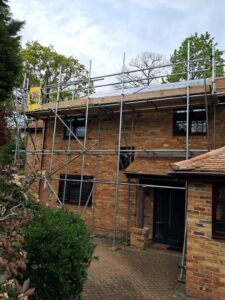
Solar panel installations often require access along the roofline so installers can work safely when fitting panels and associated equipment. Mays Scaffolding supplies solar panel scaffolding across London and the South East, including working platforms, edge protection handrails and beam-supported sections over conservatories where required. Our completed solar projects below show different installation types, with photographs, scaffold specifications, and actual costs. For a free quotation, call 020 3951 6014.
Take a look at some of our recent scaffolding projects for solar panel installations and roof access.
Installing solar panels often means working across roof areas that are difficult to reach safely from ground level. Panels, mounting rails, cables and tools all need to be taken to roof level, while installers need safe access to carry out the work.
We provide solar panel scaffolding for residential and commercial installations, from straightforward pitched roofs to larger buildings with multiple elevations or different roof levels.
Before installing the scaffold, we confirm where the solar panels will be positioned, how the installers need to access the roof and which areas they need to work from during the installation.
This lets us build the scaffold around the solar installation requirements, rather than treating the project as standard roof access.
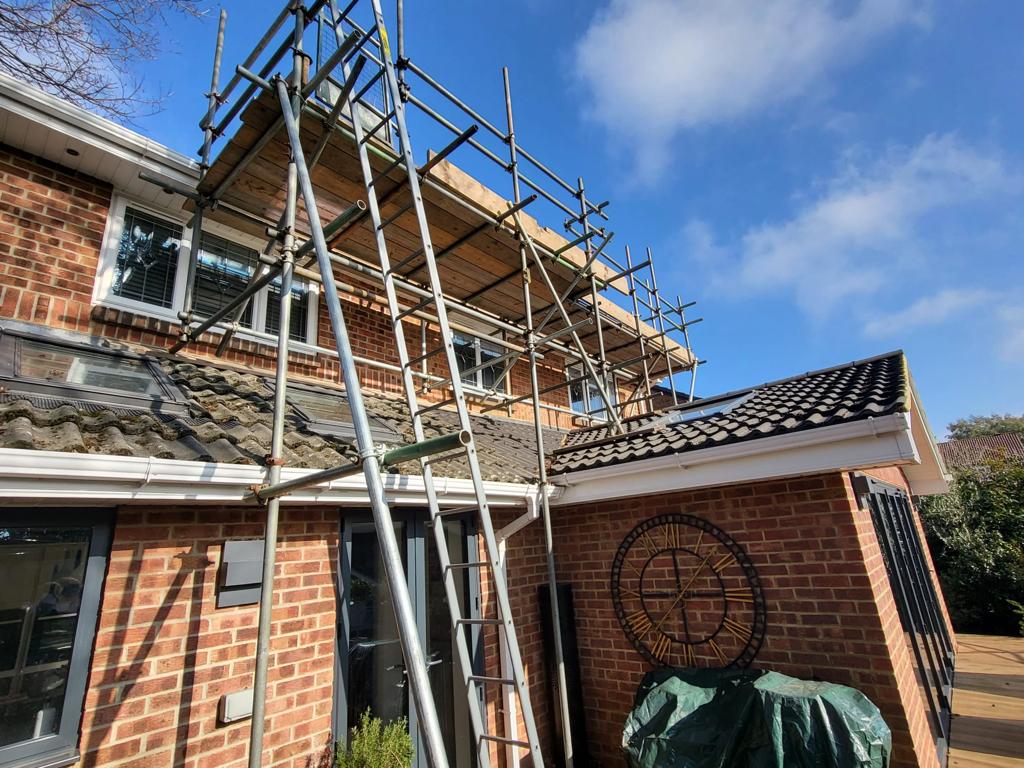
The point where installers move from the scaffold onto the roof is an important part of a solar installation.
Depending on the property and roof, we may provide a working platform below the eaves with ladder access through the scaffold. We can incorporate guardrails, ladder gates, or trapdoors where required.
We can also consider how equipment will be moved between ground, scaffold and roof level.
Solar panels are relatively large items, so the installation team’s route matters. On some projects, installers may require clear access from the scaffold. Larger installations may require extra space to handle materials or coordinate with mechanical lifting equipment.
Solar installers can spend considerable time working near roof edges while positioning rails, brackets, and panels.
Where required, we can provide roof edge protection as part of the scaffold installation.
The exact setup depends on the building and how the solar installation is being carried out. Where installers work close to the roofline, we can incorporate edge-protection handrails into the scaffold to protect exposed edges.
For industrial, agricultural and commercial roofs, the access scaffold and edge protection may also be separate parts of the same project.
Planning both together gives the installation team safe roof access while protecting the relevant roof edges.
Many domestic solar installations take place on pitched tiled or slated roofs.
For these properties, we can install scaffolding along the elevation where the panels are being fitted, providing a working level below the roof edge and access for the installation team.
We take account of features such as:
Where an obstacle prevents standards being positioned conventionally from ground level, we can look at alternative scaffold designs, including beams or cantilevered sections where appropriate.
This is particularly useful on properties where solar panels are being fitted above an extension, conservatory or other structure.
A conservatory or single-storey extension can sit directly below the roof section selected for solar panels.
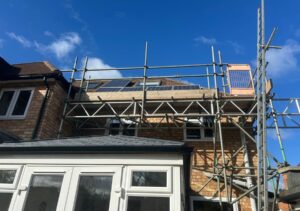
Where conservatories obstruct roof access, we can install conservatory scaffolding to create the working level solar installers need without relying on the lightweight roof beneath it for support.
Depending on the dimensions and site conditions, we may use scaffold beams to span the obstruction and create the required working platform at roof level.
The supporting scaffold can then be positioned on suitable ground either side of the obstruction.
This type of access needs careful consideration before installation because the span, scaffold height, loading and available support positions can all affect the final design.

Solar installations are increasingly installed on warehouses, offices, workshops, retail buildings, and other commercial premises.
These projects can involve much larger roof areas than a residential installation and may require access to remain in place while substantial numbers of panels are fitted.
We can provide scaffolds for commercial solar projects, including:
If the building remains occupied during installation, we can also consider entrances, pedestrian routes, loading areas, shutters, and vehicle access when planning the scaffold.
This is particularly important on industrial estates and working commercial sites where the solar installation takes place alongside normal business activity.
Barns and agricultural buildings can present very different access requirements from houses.
Roof areas are often considerably larger, eaves can be higher, and the structure may be surrounded by uneven ground, yards or working areas.
Solar projects on agricultural buildings can also involve large numbers of panels and substantial quantities of equipment being moved to roof level.
We can provide access scaffold, loading areas and edge protection for this type of work.
Where a crane, telehandler or other lifting equipment is being used to move panels or materials, we can plan the scaffold with the lifting operation in mind and leave suitable access where required.
Larger solar installations may involve dozens or hundreds of panels together with mounting rails and associated equipment.
On these projects, a standard access tower may not provide everything the installation team requires.
We can build scaffold loading bays where you need space at height for materials. We can plan the dimensions and position around the building, installation method, and intended method of lifting materials.
If panels are lifted mechanically rather than carried through the scaffold, we can discuss this before installation so the scaffold does not obstruct the lifting route.
Not every solar array is installed on one continuous roof.
A property may have panels planned for the main roof and an extension, while a commercial building may have several roof sections at different heights.
We can provide scaffold access to suit these level changes.
This may involve separate platforms, additional lifts, access towers or scaffold positioned on more than one elevation.
Knowing the proposed panel positions before we arrive helps us plan access around the actual solar layout.
Scaffolding is not only required when panels are first installed.
Existing solar systems may need access for:
If panels need to be temporarily removed for roofing work, we can provide access for both the solar contractor and roofer.
There is no single price for solar panel scaffolding because the required amount and type of access vary significantly between properties.
The price can be affected by:
A straightforward domestic installation generally requires considerably less scaffolding than a large commercial roof with access towers, edge protection, and material loading areas.
Providing photographs and details of the proposed solar installation allows us to establish what is required and provide a quotation based on the actual project.
To help with project budgeting, our guide to how much scaffolding costs provides further pricing information for planning your scaffold requirements.
The working level depends on the roof, eaves and how the installers intend to access it. We set the scaffold height to provide practical access at the roof edge while maintaining the required guardrails and protection.
Yes, we can provide access above conservatories where the site allows it. This may involve scaffold beams spanning the conservatory with the main support positioned on suitable ground. We would normally assess the dimensions and available support positions before confirming the scaffold required.
That depends on the panel size, the scaffold layout, and the installation method. On larger projects, panels may be lifted mechanically instead.
Not for every installation. Smaller residential projects may not require one, whereas larger commercial or agricultural installations can benefit from a dedicated scaffold loading area for rails, fixings and other materials. We can include this where required.
In some situations, we can provide separate edge protection where another suitable method already provides roof access. We would need to establish the roof layout, working area, and how installers reach roof level before confirming the appropriate scaffold.
We can provide access to multiple elevations where required. The scaffold layout will depend on which roof slopes receive panels and how installers intend to move between different work areas.
Yes, we regularly provide scaffold access for solar installations on barns and other agricultural buildings. These projects can include access towers, working platforms, edge protection and loading areas, depending on the building and installation method.
We can work directly with the solar contractor, particularly where they have specific requirements for platform height, material handling or roof access. This can be useful on larger or more complicated installations.
The hire period can cover roofing work as well as the solar installation, where agreed as part of the project. If both trades need the scaffold, it is useful to establish their access requirements before we install it.
It is particularly useful on larger installations. For a straightforward residential project, photos and roof details may be enough. For commercial, agricultural or multi-roof installations, a panel layout or drawing can help us establish exactly where access and edge protection are required.
Whether you are installing solar panels on a house, commercial property, warehouse or agricultural building, we can provide scaffold access planned around the roof and the work being carried out.
Send us photographs of the property, along with details of where the panels are being installed, or contact us to arrange a site visit for larger projects.