Tailored to your property.
Scaffold hire periods to suit your project.
London, Surrey, Sussex, Hampshire, Berkshire & Kent.
Provided where required.
Working near exposed roof edges presents a serious fall risk, particularly during roof replacements, new builds and structural alterations. Mays Scaffolding supplies and installs scaffold edge protection across London and the South East, including temporary guardrails and handrail systems for residential and commercial projects. Our previous installations below show different types of edge protection, with photographs, project specifications and actual costs. Call 020 3951 6014 for a free quotation.
Some jobs require a complete scaffold. Others only need protection along an exposed edge.
See recent examples of handrails and edge protection we have installed for specific working areas.
A roofer working from a flat roof doesn’t necessarily need another platform beneath them. A contractor working on a raised section of a building may already have access to the work area.
The issue can simply be the unprotected edge beside them.
This is where scaffold edge protection differs from an access scaffold. Instead of providing a working platform, the scaffold forms a temporary barrier along the side of the existing work area.
It can run along a short section or around a larger perimeter, depending on which exposed edges need protection.

Our temporary edge protection barriers are typically constructed from scaffold tube and fittings, with standards supporting horizontal guardrails along the required edge.
Intermediate rails and toe boards can also form part of the structure where required, together with the bracing, ties or other components needed for the particular installation.
This means the handrail isn’t simply a loose barrier placed at roof level. It forms part of a scaffold structure built specifically for the area being protected.
How the structure is supported matters, particularly when the handrail is installed on or alongside an existing building.
If contractors can already access a flat roof from inside the building, a full scaffold running up the outside elevation may not be necessary. The main requirement may simply be edge protection around the work area.
However, where external roof access is also required, our roofing scaffolding solutions provide working platforms for roofers carrying out repairs, maintenance and other work at height.
A handrail scaffold can protect a particular exposed edge without scaffolding the entire elevation. When work is limited to one section of a roof, the protection can be focused on that area rather than extending around parts of the building that aren’t involved.
Exposed edges can occur in plenty of other places.
A raised storage area inside an agricultural building, for example, presents a very different site from the roof of a house, but temporary handrails can serve a similar purpose.
Edge protection may be required around:
This is why we don’t treat edge protection as a product with one standard shape or size. We first establish which edge needs protecting and what surrounds it.
Installing edge protection isn’t only about the length of the area that needs protecting. The structure also needs suitable positions from which it can be supported.
On some sites, these positions are readily available. On others, lower roofs, equipment, restricted floor space or parts of the existing building can limit where scaffold components can be placed.
In these situations, the handrail structure can be planned around the available space, using the appropriate standards, bracing, and tie-backs to support the protected section without unnecessarily scaffolding a larger area of the building.

Edge protection projects aren’t necessarily large.
A short run of handrail protecting one exposed section can be all that is required for safety.
This is one reason it helps to show us exactly where the work will take place, rather than simply asking for a price for “edge protection”. The length of the open edge is only one part of the picture; its height, surroundings, and available support positions also matter.
Photographs are particularly useful for smaller or unusual areas because they show the edge in relation to the rest of the structure.
The cost of scaffold edge protection depends on how much exposed area needs protection and what is required to support the handrail structure.
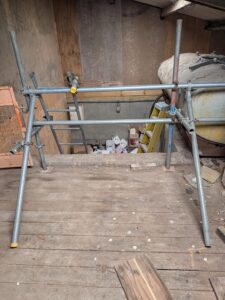
A short section of temporary handrail can be a relatively small scaffold job. For example, our recent A-frame handrail in Woking cost £350 for two weeks’ hire, with approximately 2.4 metres of edge protection installed on an internal single-storey storage area.
Larger installations can cost more where the handrail needs to extend along several sides of a roof or where additional scaffold is required to support the edge protection.
Other factors that can affect the price include the height and location of the working area, site access, the complexity of the supporting structure, and the length of the hire period.
For more examples of recent prices, our scaffolding hire costs page explains what we have charged for different types of scaffold and some of the factors that can affect the overall cost.
Accessing the roof and protecting its exposed edges are separate considerations. Your contractor should establish what protection is required for the work being carried out. If you need scaffold edge protection, we can provide the temporary handrail structure.
In some situations, yes, an edge protection structure can be supported from an existing part of a building rather than forming a conventional scaffold from ground level. Whether this is possible depends on the building and available positions, so our team will need to assess the proposed location.
Yes, where an A-frame arrangement suits the location. We have used this type of structure for specific edge-protection requirements, including our handrail installation at Ockham Park Farm in Woking.
It depends on the parapet, the work taking place and the scaffold arrangement required. Send us photographs showing the parapet and surrounding area so we can see what is involved.
If the work overruns, contact us before the agreed hire period ends. We can confirm the costs to extend the hire.
Contractors or other people using the site shouldn’t alter the installed scaffold. If the work changes and the handrail needs extending, repositioning, or otherwise modifying, contact us so we can assess the alteration and carry it out appropriately.
Wide photographs showing the complete working area are generally more useful than close-ups of the edge alone. Try to show the exposed edge, the area immediately behind it and the structure below or around it. Additional photographs from different angles can help where the location is unusual.
If so, show us where the work is taking place and which edge needs protecting.
Send a few photos of the location and a brief description of the work, and we can advise what type of edge protection is required.